Sacred & Pure: The Vital Role of Kusha Grass (Darbha) in Tarpan
Ever wondered about the real Kusha grass significance Tarpan? Why is this simple-looking Darbha absolutely essential when honouring our ancestors (Pitṛs)? This article unveils its profound, indispensable role, drawing directly from sacred Puranas. Discover its stunning divine origins – born from Lord Vishnu's very hair and housing the Holy Trinity (Brahma, Vishnu, Shiva) within each blade, a truth revealed in the Garuda and Padma Puranas. This inherent sanctity grants it unparalleled purifying power, capable of elevating rituals even without mantras! But how exactly does it function so critically in Pitru Tarpan? Learn its multifaceted uses: as a vital component mixed with offerings, a sacred conduit channeling your prayers and intentions, a purifying seat (Asana) insulating from negative energies, a ring (Pavitri) ensuring the performer's constant ritual purity, and a potent amplifier of the entire ritual's energy, as detailed in the Skanda Purana. Its significance extends even further – how is it critically involved in death rites and daily Dharmic practices? What led the Puranas to declare Darbha "the most sacred of sacred things," making rituals potentially incomplete without it? Is it merely about purity, or does it possess deeper protective and energetic properties essential for bridging worlds? Uncover the secrets behind Darbha's vital role and why understanding it transforms your Tarpan practice from mere action to conscious communion.
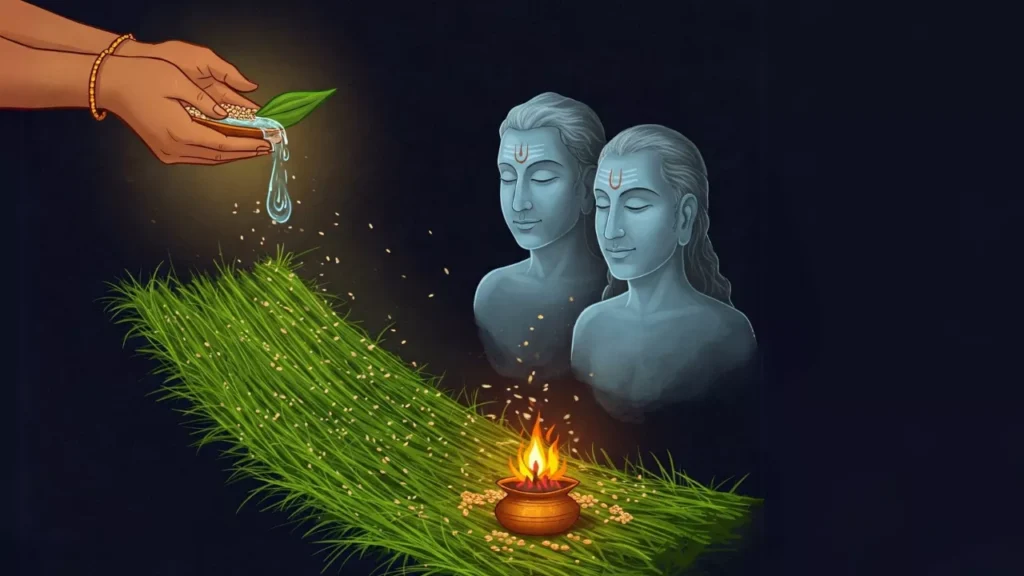
Namaste,
Today, our focus turns to something seemingly simple, yet intrinsically powerful – the sacred Kusha grass, more intimately known amongst us as Darbha. You inquire about its role, particularly its vital importance in the solemn ritual of Tarpan, the offering we make to honour and nourish our departed ancestors (Pitṛs).
Darbha! This is not mere grass. It is a strand connecting the earthly to the divine, a conduit of purity vibrating with ancient energy. Having spent countless cycles of seasons immersed in the wisdom whispered through our Puranas, I shall endeavour to shed light on the Kusha grass significance Tarpan, drawing upon the timeless truths enshrined in texts like the Garuda Purana, Skanda Purana, Padma Purana, and others.
Sacred & Pure: Unveiling the Vital Role and Significance of Kusha Grass (Darbha) in Tarpan
When we perform rituals, especially those as significant as Pitru Tarpan, every element, every implement, carries weight and meaning. We don’t use things arbitrarily. The choice of materials is guided by an ancient understanding of their inherent properties and their resonance with the divine and subtle realms. Among these, Kusha grass stands out for its ubiquitous presence and fundamental importance. To truly appreciate the Kusha grass significance Tarpan, we must first understand its sacred origins and unparalleled purity.
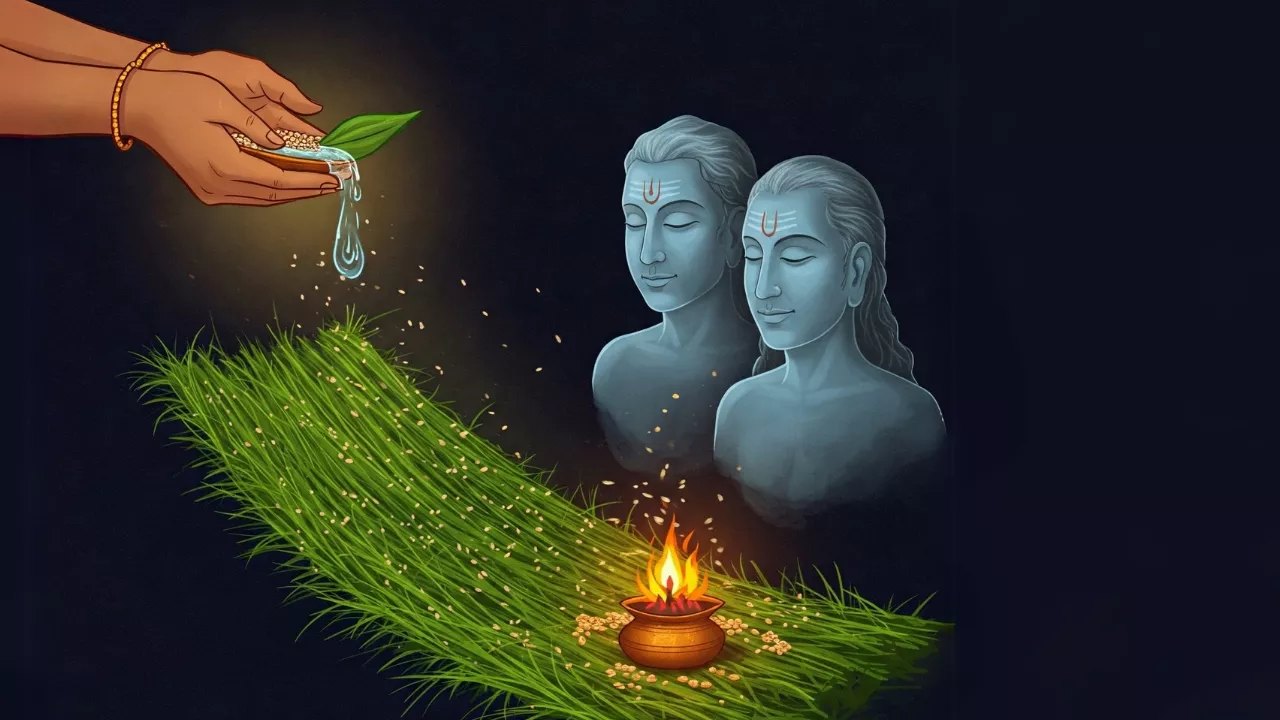
The Sacred Source: Divine Origins and Unmatched Purity of Kusha Grass
The very genesis of Kusha grass sets it apart from common vegetation. It is not merely born of earth and water; its roots trace back to the divine realm itself.
- Born of the Divine: The revered Garuda Purana offers a stunning revelation: Darbha grass is described as being born from the very hair of Lord Vishnu! Ponder this for a moment – strands of grass springing forth from the divine form. This celestial origin immediately imbues Kusha with an extraordinary level of sanctity, making it inherently fit for the most sacred purposes.
- Innate Purifying Power: Its divine birth grants Kusha an intrinsic power to purify. The Garuda Purana further clarifies that anything wrapped in Darbha, or sprinkled with water using Darbha blades (prokṣaṇa), achieves purity even without the chanting of specific mantras. This innate ability to cleanse and sanctify is a cornerstone of its ritualistic importance. Imagine – its mere presence can elevate the energetic quality of a space, object, or offering. The same Purana mentions that uncut Kusha, when pointed correctly (East, North, or West), can even attract the sacred fire, highlighting its connection to Agni Deva and its inherent energy.
- Abode of the Trimurti: Further cementing its supreme status, both the Padma Purana and the Garuda Purana reveal that the Holy Trinity resides within its structure: “Brahmā is stationed at the root of the Kuśa grass, Keśava (Viṣṇu) is stationed in the middle and Śaṅkara (Śiva) is stationed at the tip of the Kuśa grass.” This makes each blade of Darbha a microcosm of the divine creative, preservative, and destructive forces – a complete representation of cosmic reality. Holding Kusha is, in a sense, holding the divine itself.
This inherent, divinely ordained purity and power make Kusha grass not just suitable, but essential, for creating the appropriate sacred atmosphere required for rituals like Tarpan, where interaction with subtle realms occurs.
The Heart of the Matter: Kusha Grass Significance in Tarpan and Pitru Rites
Now, let us focus specifically on Tarpan and other rites dedicated to our ancestors (Pitṛ Karmā). Here, the Kusha grass significance Tarpan becomes most apparent. It’s not merely an accessory; it’s deeply integrated into the procedure and purpose of the offering.
- Essential Component of the Offering: The Skanda Purana is quite direct, advising that the Tarpan rite for the Manes (ancestors) should be performed “with Darbhas mixed with gingelly seeds (sesame).” This explicitly links Kusha with the primary offering materials (water and black sesame seeds). It also mentions that during Shraddha (a more elaborate ancestral rite), the libation with sesame seeds should be offered while holding Darbha grass in one hand.
- Creating a Pure Conduit: Why hold Darbha or mix it with the offering? Kusha acts as a sacred conduit. Its purity ensures that the offering is not contaminated by base energies and that the performer’s intentions and prayers are transmitted effectively. It helps channel the energy of the mantras and the bhāva (devotional feeling) towards the intended recipients – the Pitṛs. Think of it as an antenna tuning into the frequency of the ancestral realm.
- Providing a Sacred Seat (Asana): Often, Kusha blades are spread on the ground where the Tarpan water is offered, or the vessel (pātra) containing the offering is placed upon a base of Kusha. This creates a purified space, a symbolic sacred seat (āsana) inviting the ancestors to come and accept the offerings without interference from negative ground energies.
- Maintaining Performer’s Purity (Pavitri): A ring fashioned from Kusha grass, known as a Pavitri, is traditionally worn on the ring finger of the right hand by the person performing the ritual. This constantly keeps the performer in a state of ritual purity, ensuring their actions are efficacious.
- Enhancing Ritual Efficacy: The Padma Purana states that water touched by Kusha is superior even to nectar (amṛta). It also claims that reciting a hymn with Kusha in hand multiplies its effect manifold (hundredfold generally, thousandfold at a sacred place). This underscores Kusha’s role as an amplifier of sacred energy, making the Tarpan ritual significantly more potent and beneficial.
- Protection: Just as it purifies, Kusha is also believed to possess protective qualities (rakṣoghna – destroyer of negative entities). Its presence helps ward off any disruptive or inauspicious influences that might seek to interfere with the sacred rite or disturb the peace of the ancestors being invoked.
The Brahma Purana, while mentioning Tarpan with sesame and water, operates within the established ritualistic framework where the inclusion of Darbha, as mandated by other texts like Skanda Purana, is understood. The collective wisdom of the Puranas confirms that Kusha is inseparable from the proper performance of Pitru Tarpan. Its significance is multi-layered: it purifies, protects, connects, enhances, and validates the entire process.
Beyond Tarpan: Kusha’s Pervasive Presence in Dharmic Practices
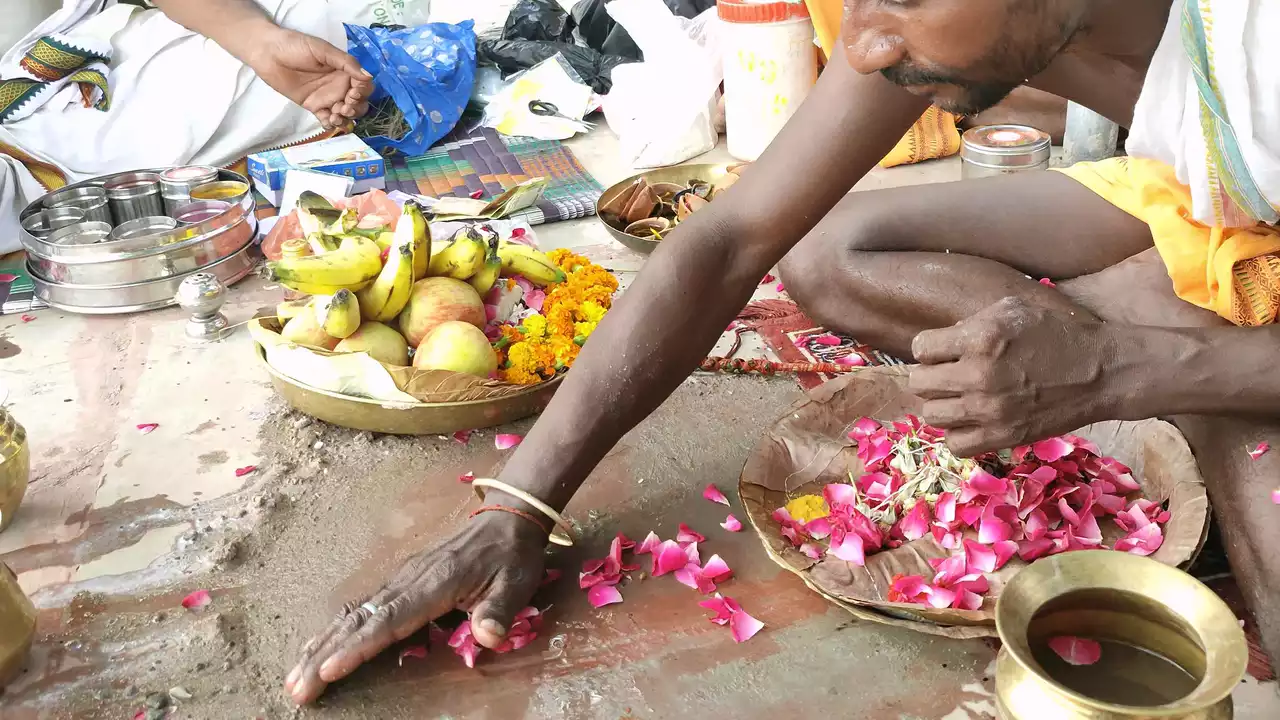
The profound significance of Kusha grass is not limited to Tarpan. Its use permeates a vast array of Hindu rituals and practices, further highlighting its fundamental importance in our tradition.
Purification (Shuddhi Karma)
- Water Purification: As mentioned, sprinkling water with Kusha blades (prokṣaṇa) purifies spaces, objects, and even people. The Linga Purana advises scattering Kusha into holy water before bathing, enhancing the purificatory power of the bath itself.
- Purifying Ritual Implements: The same Purana describes meticulously wiping sacred ladles (sruva) used in fire sacrifices (yajña) with a specific number of Kusha blades to maintain their sanctity.
- Cleansing Defiled Items: If substances like grains become ritually impure (aśuddha), the Linga Purana prescribes sprinkling them with Kusha-infused water as a method of restoring purity.
Rites of Passage (Samskaras) & Death Rites
- Presence at Death: The Garuda Purana details the practice of strewing Darbha grass near the bed of a dying person. This is believed to create a protective and sacred field around them during their transition.
- Preparing the Departed: The same text instructs that the deceased body should be enveloped (ācchādana) with Darbha grass and placed on a bier or bed made of Kusha. This act is said to purify the body and aid the soul’s journey, ensuring attainment of Vishnu’s realm (Viṣṇu Loka) or heaven (svarga). Even providing a simple bunch of Darbha for the deathbed holds immense merit.
- Enhancing Charity at Death: Giving charity (dāna) from a space smeared with cow dung where a deathbed of Kusha grass is placed is said, according to the Garuda Purana, to dispel all sins, magnifying the merit of the final acts of giving.
Daily Rituals (Nitya Karma)
- Sandhyāvandanam: During the daily twilight prayers (Sandhyā), the Skanda Purana advises holding Darbha grass in hand while meditating on the divine, especially when seated near a Tulasi plant. It posits that a rite without Darbha is incomplete, akin to Sandhya prayers performed without it.
- Arghya Offering: The respectful offering of water (Arghya) to deities like the Sun God often includes specific ingredients. The Skanda Purana lists Darbha grass as one of the nine essential constituents (navadravya) of Arghya, signifying respect and purity.
Healing and Well-being
- Medicinal and Protective Properties: The Agni Purana touches upon the physical benefits, associating Kusha grass (originating from Vasudeva’s body in its narrative) with cleansing properties that can ward off diseases. This hints at an ancient understanding of its potential health benefits alongside its spiritual ones.
This widespread application underscores that Kusha is not just for priests or complex ceremonies; it’s a fundamental element woven into the fabric of daily and occasional Dharmic life, from birth to death and beyond.
Puranic Declarations: Understanding the Unwavering Sanctity of Darbha
Our sacred texts don’t merely suggest using Kusha; they make powerful declarations about its nature and importance, leaving no room for doubt about its vital role.
- Perpetual Purity: A remarkable quality highlighted in the Puranas (e.g., Garuda Purana) is that Kusha grass generally does not become impure through use in rituals, unlike many other materials. It can be reused in many contexts because its inherent purity is considered self-renewing.
- The Exception: Pinda Daan: Interestingly, the Garuda Purana notes an exception: Kusha used in direct contact with Pindas (the rice balls offered during Shraddha) does become impure afterwards. This isn’t a contradiction but highlights Kusha’s function: it absorbs the specific energies and impurities associated with the preta state (the initial state after death before becoming a Pitṛ) symbolized by the Pinda, thereby purifying the offering but becoming imbued with that specific impurity itself. It fulfills its purpose and is then respectfully discarded.
- Essential for Auspiciousness: The Skanda Purana proclaims Darbha as “highly beneficial and befitting Yajnas (sacrifices).” It goes further, stating unequivocally: “Without Darbha, no auspicious rite can become complete.” This positions Kusha not just as helpful, but as a prerequisite for ritual success and auspiciousness (maṅgala).
- Supreme Sacredness: The same Purana elevates it further: “Darbha is the most sacred of all sacred things; it is the most auspicious of all auspicious things.” Such superlative praise underscores its unparalleled status in the hierarchy of ritual implements.
These scriptural affirmations solidify the Kusha grass significance Tarpan and in all sacred activities. It is presented as a divine gift, essential for maintaining purity, ensuring efficacy, and invoking auspiciousness.
Practical Guidance: How to Incorporate Kusha Grass in Your Tarpan Ritual
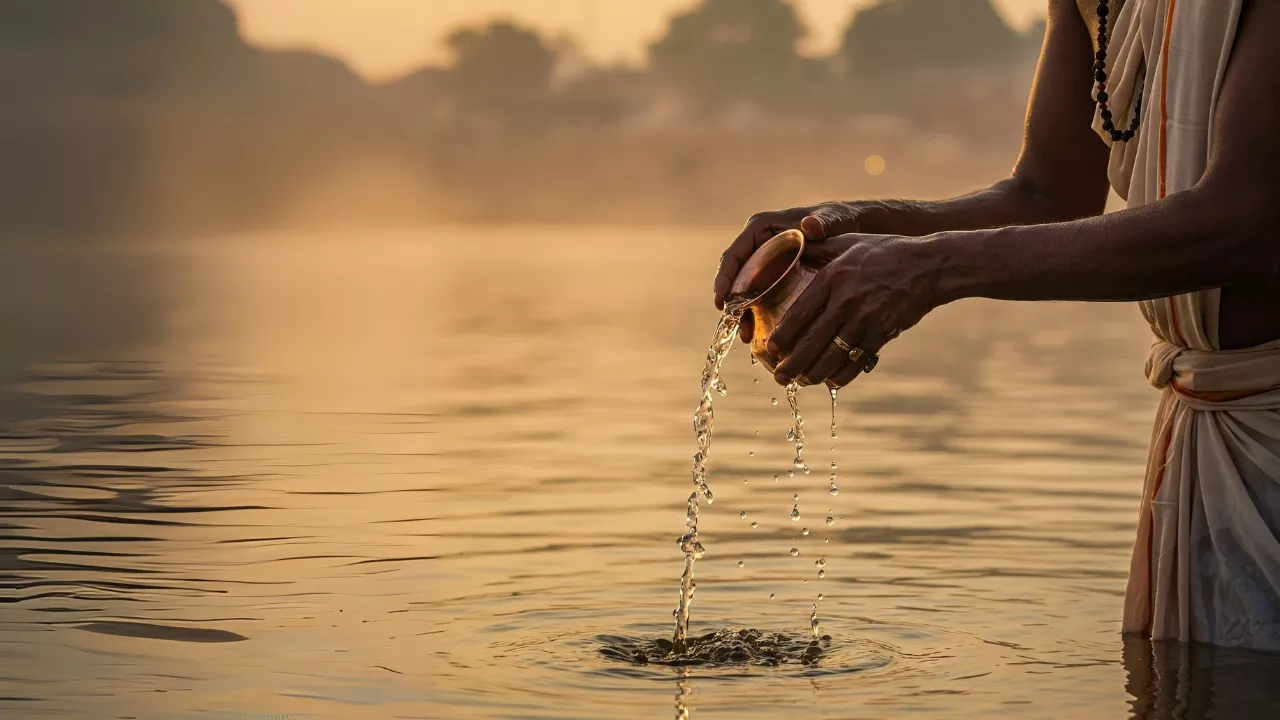
Understanding the significance naturally leads to the question: how is Kusha practically used in Tarpan? Here are the common applications:
- The Pavitri Ring: A ring meticulously twisted from two or three blades of Kusha grass is worn on the ring finger of the right hand. This constantly purifies the performer’s hand, the primary instrument of offering.
- Asana (Seat): If performing Tarpan seated on the ground, using a mat woven from Kusha grass (Kuśāsana) provides insulation from impure ground energies and establishes a sacred space.
- Held Blades: Several blades of Kusha may be held in the hand, often tucked between the fingers or held along with sesame seeds, during the water offering (Tarpan). The tips should generally point towards the South (the direction of the Pitṛs) during Pitru Tarpan. This acts as the direct channel for the offering.
- Under the Vessel: A few blades of Kusha are often placed on the ground or plate where the Tarpan water is collected. The main water vessel or the receiving vessel might also be placed upon these blades to ensure the offering remains pure.
While sourcing authentic Kusha grass is ideal, if it proves difficult, the emphasis should remain on maintaining utmost internal and external purity and focusing sincerely on the ancestors. However, understanding why Kusha is used deepens the appreciation and intention behind the ritual, even if substitutes or mental visualizations are employed out of necessity.
Conclusion: Embracing the Sacred Strands of Connection
As we have journeyed through the wisdom of the Puranas – the Garuda Purana, Brahma Purana, Skanda Purana, Linga Purana, Padma Purana, and Agni Purana – the vital Kusha grass significance Tarpan has become luminously clear.
Born from the divine, inherently pure, abode of the Trimurti, amplifier of mantras, conduit to the ancestors, protector from negativity, and indispensable for ritual purity and success – Kusha grass is far more than meets the eye. It is a sacred instrument, a gift from the divine, designed to aid us in our most profound duties, including the sacred obligation we owe to our Pitṛs.
When you next hold Darbha in your hand during Tarpan, remember its journey from the cosmic hair of Vishnu, feel the presence of Brahma, Vishnu, and Shiva within it, and understand its role as the pure channel carrying your love and offerings across the veil to your ancestors. Use it with reverence, with understanding, and with a heart full of gratitude.
May the purity of Kusha grass sanctify your offerings, may your connection with your ancestors deepen, and may their benevolent blessings flow freely into your life, guided by these sacred strands.
|| कल्याणमस्तु ||
Considering a rite for your own family?
Tell us what your family needs and a coordinator will contact you personally. No online payment is requested.
Send an enquiry