Suffering from Pitru Dosha? How Pind Daan Can Offer Relief and Solutions
Are persistent family problems, unexplained obstacles, or a sense of unease casting a shadow over your life? Could these be signs of Pitru Dosha, the subtle imbalance caused by ancestral dissatisfaction? This exploration delves into the connection between Pind Daan Pitru Dosha, revealing how the sacred act of Pind Daan within the Shradh ceremony offers a profound pathway to relief. But how exactly does offering a simple Pinda (rice ball) address these deep-seated issues rooted in lineage? Discover the Puranic wisdom explaining how Pind Daan provides crucial satisfaction (Tripti) to restless ancestors, alleviating their suffering and transforming their energy from distress to blessings. Learn its vital role in helping trapped souls (Pretas) transition peacefully, effectively removing a source of potential disturbance. How does this ritual help dissolve the karmic burden of ancestral debt (Pitru Rin)? Find out why performing Pind Daan, especially at potent Tirthas like Gaya, is considered a powerful remedy, capable of invoking blessings and dispelling negativity. If you're seeking solutions and solace, understanding the principles behind Pind Daan is key. Dive into the full article to uncover the scriptural basis and practical steps for this healing ritual.
Namaste,
It is a concept that can cause anxiety, yet our Sanatan Dharma, in its boundless wisdom and compassion, not only diagnoses such subtle ailments but also provides profound remedies. Today, let us explore this sensitive topic together, understanding how the sacred act of Pind Daan, performed with faith and diligence, can offer solace and solutions, particularly concerning issues often labelled as Pind Daan Pitru Dosha.
Suffering from Pitru Dosha? How Pind Daan Can Offer Relief and Solutions
Life unfolds according to our karma, the intricate web of actions and consequences from this life and previous ones. However, our connection to our lineage, our kula, runs deep, extending beyond the visible world. The well-being of our ancestors, their state of satisfaction (tripti) or dissatisfaction (atripti), can subtly influence the lives of their descendants.

Understanding the Shadows: What is Pitru Dosha? (पितृ दोष क्या है?)
What exactly do we mean by Pitru Dosha? It’s not a curse in the simplistic sense, but rather a reflection of an imbalance, a spiritual debt, or the unresolved suffering of ancestors impacting the present generation. The Puranas hint at situations where such influences might manifest.
The Garuda Purana, a text deeply concerned with the afterlife, describes how the suffering caused by Pretas – souls of the departed who are stuck in transition, not yet having attained the peaceful state of a Pitr – can manifest in the lives of the living [Garuda Purana]. It lists various afflictions: persistent pain or illness, immense suffering for a spouse, loss of faith in sacred texts and traditions, disrespect towards elders or deities, loss of livelihood or social standing, breaks in the family lineage (difficulty conceiving, miscarriages, lack of male heirs) [Garuda Purana]. While not every problem stems from this cause, persistent, seemingly inexplicable patterns of misfortune in a family are sometimes investigated by the wise through astrological charts (jyotisha) or intuitive understanding as potentially linked to the state of the ancestors.
This connection arises because we are part of an unbroken chain. Just as we inherit physical traits, we also inherit subtle karmic and energetic connections. If our ancestors are suffering, trapped, or deeply unsatisfied, their subtle vibrations of distress can create disturbances or obstacles in the lives of their descendants who share that energetic lineage.
The Sacred Path to Light: Shradh and Pind Daan (श्राद्ध एवं पिण्ड दान)
Faced with such possibilities, does our Dharma leave us helpless? Absolutely not, my child. It offers powerful tools for healing and reconciliation across generations. The primary framework for this is the Shradh ceremony (श्राद्ध).
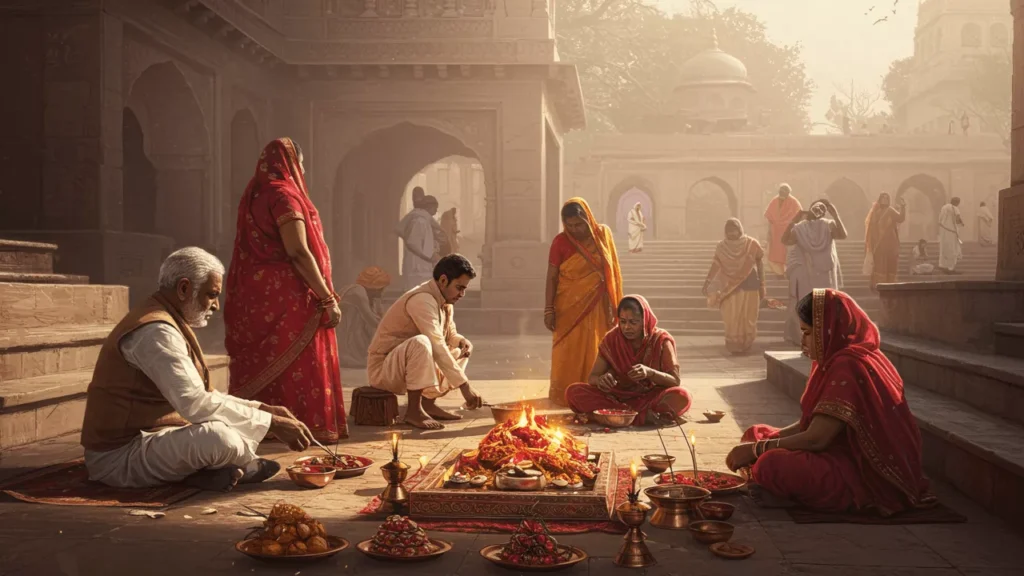
Shradh is the sacred duty, the act of faith, performed to honour, remember, and nourish our departed ancestors. It is a bridge of love and gratitude built across realms. Within this vital ceremony, the offering of the Pinda (पिण्ड) holds a place of unparalleled significance.
As we’ve discussed before, the Pinda is typically a ball made from cooked rice or barley flour, often mixed with pure ingredients like ghee, black sesame seeds (til), milk, or honey. It is offered with deep reverence (bhakti) and specific mantras, usually upon sacred Kusha grass.
Now, let us understand how this seemingly simple offering, Pind Daan, becomes the cornerstone for addressing issues related to ancestral dissatisfaction, acting as a potent remedy in situations identified as Pind Daan Pitru Dosha<span style=”font-weight: 400;”>.
How Pind Daan Offers Relief: Addressing the Root Causes (पिण्ड दान से समाधान)

Pind Daan works on multiple subtle levels to address the potential root causes of Pitru Dosha and bring relief.
1. Providing Profound Satisfaction (Pitru Tripti – पितृ तृप्ति):
The most fundamental aim and effect of Pind Daan is to bring deep and lasting satisfaction (tripti) to the Pitrs. Dissatisfied ancestors are often considered a primary cause behind Pitru Dosha. When the ancestors are content, their blessings flow freely.
- Lasting Contentment: The Puranas repeatedly emphasize the profound satisfaction Pind Daan provides. The Garuda Purana notes that offerings (Tarpana) made at sacred spots can satiate the manes forever [Garuda Purana]. The Skanda Purana highlights specific Tirthas (holy places) like Gaya, where performing Shradh brings permanent satisfaction (Akshaya Tripti) to the Pitrs [Skanda Purana]. Similarly, the Vayu Purana states that a Shradh at Gaya yields endless benefit, perpetually satisfying the ancestors [Vayu Purana].
- Alleviating Distress: When ancestors receive this nourishment and respect through Pind Daan, their own suffering diminishes. Their contentment directly translates into positive energy for the lineage, counteracting the negative influences of their previous dissatisfaction. This is the foundational step in resolving afflictions linked to Pitru Dosha.
2. Facilitating the Soul’s Journey (Preta Mukti – प्रेत मुक्ति):
As the Garuda Purana warns, trapped Pretas can be a source of suffering. A soul might become stuck in this state due to an unnatural death, unfulfilled desires, or lack of proper funeral rites. Pind Daan is the key ritual that helps these souls complete their transition.
- Building the subtle body: As mentioned earlier, the initial pindas offered after death help the soul form the necessary subtle body for its onward journey [Garuda Purana].
- Merging with Ancestors (Sapindikarana): The crucial Sapindikarana rite, centered around Pinda offerings, formally integrates the Preta into the collective body of Pitrs. This ends their solitary, potentially troubled existence. The Vamana Purana directly states that Pind Daan ensures relief from the Pretayoni (state of being a Preta) [Vamana Purana]. The Skanda Purana recounts instances where performing Shradh liberated a father from the state of a Preta because proper rites (like Vrsotsarga or the sixteen monthly Shradhs) were initially missed [Skanda Purana].
- Removing the Source of Trouble: By helping these trapped souls find peace and their rightful place among the Pitrs, Pind Daan removes a significant potential source of disturbance and suffering for the living family members. Addressing the state of these Pretas is often central to resolving issues diagnosed through the lens of Pind Daan Pitru Dosha.
3. Dissolving the Ancestral Debt (Pitru Rin Mukti – पितृ ऋण मुक्ति):
We are born indebted to our ancestors for our very life and lineage (Pitru Rin). This unresolved spiritual debt can act as a subtle karmic burden, manifesting as obstacles or lack of progress.
- Freedom from Obligation: Performing Shradh and Pind Daan is the prescribed method to acknowledge and repay this sacred debt. The Garuda Purana explicitly states that performing Shradh frees one from debts to the manes [Garuda Purana]. The Skanda Purana also confirms that performing these rites frees one from indebtedness to the Pitru Loka (ancestral realm) and the Pitrs [Skanda Purana].
- Clearing Karmic Pathways: By fulfilling this fundamental duty, the descendant clears a significant karmic slate, potentially removing blockages that were hindering their well-being and progress. This is another way Pind Daan contributes to overall relief.
4. Invoking Blessings and Removing Obstacles (Ashirvad Prapti aur Vighna Nashan – आशीर्वाद प्राप्ति और विघ्न नाशन):
When the Pitrs are satisfied and the debts are cleared through diligent performance of Pind Daan, their energy shifts from potential distress to benevolent grace.
- Flow of Blessings: Pleased Pitrs bestow abundant blessings. The Siva Purana beautifully states that those who perform Shradh rites bring delight to all, fueled by the favour (prasada) of the manes [Siva Purana]. These blessings manifest as piety, worthy progeny, health, and nourishment.
- Dispelling Sufferings: Pind Daan, especially when performed with devotion at sacred sites, has the power to actively dispel suffering and remove obstacles. The Skanda Purana is replete with descriptions of Tirthas where performing Shradh and Pind Daan destroys great sins (maha pataka nashanam), removes all obstacles (sarva vighna vinashanam), alleviates fear of judgment (Yama loka bhaya apaham), destroys torments, quells ailments (roga nashanam), and eradicates sins [Skanda Purana]. Even poverty is said to be averted by feeding Brahmins for the Pitrs during specific times [Skanda Purana].
- Transforming Misfortune: This power to avert disasters and transform misfortune into good fortune is a direct answer to the troubles associated with Pitru Dosha.
5. Amplifying Efficacy at Sacred Places (Tirtha Mahatmya – तीर्थ माहात्म्य):
While Pind Daan performed anywhere with faith is beneficial, its potency is immensely magnified when conducted at specific holy places designated for ancestral rites.
- Power Spots: Places like Gaya (considered the most pre-eminent), Prayagraj (Allahabad), Kashi (Varanasi), Rameshwaram, Siddhpur, Pushkar, Ujjain, Nasik, and banks of sacred rivers like Ganga, Yamuna, Godavari, Narmada are imbued with special spiritual energy conducive to these rites.
- Exponential Merit: The Puranas extol the virtues of performing Shradh and Pind Daan at these Tirthas. The Skanda Purana often equates the merit gained at certain spots to performing thousands of Shradhs elsewhere or yielding manifold benefits [Skanda Purana]. The Garuda Purana also recommends specific ponds and locations for Tarpana and Shradh [Garuda Purana].
- Targeted Remedy: For deep-seated or persistent issues suspected to be linked to Pitru Dosha, undertaking a pilgrimage (yatra) to perform Pind Daan at a major Tirtha like Gaya is often recommended by priests and astrologers as a powerful and direct remedial measure. Seeking relief through Pind Daan Pitru Dosha remedies often involves performing the rites at such potent locations.
The Unseen Ingredients: Faith, Purity, and Procedure (Shradh, Shuddhata, Vidhi – श्रद्धा, शुद्धता, विधि)
It is crucial to understand that Pind Daan is not magic. Its effectiveness hinges on several vital factors:
- Unwavering Faith (Shradh): The ritual must be performed with genuine belief and reverence. Puranas repeatedly state that rites performed without faith are futile.
- Purity (Shuddhata): The performer must maintain physical and mental purity. The offerings should be prepared cleanly, and the ingredients should be pure and acquired through righteous means (nyaya).
- Correct Procedure (Vidhi): Following the prescribed steps, chanting the appropriate mantras learned from a qualified Guru or purohit, is essential for directing the ritual energy correctly.
- Sincere Intention (Bhaav): The feeling behind the act – love, gratitude, a genuine desire for the ancestors’ well-being – is paramount.
Seeking Guidance: The Role of the Wise (Vidvan Jan ka Margadarshan – विद्वान् जन का मार्गदर्शन)
If you suspect issues related to Pitru Dosha might be affecting your family, it is wise to consult with a knowledgeable and ethical astrologer (Jyotishi) or a learned family priest (purohit). They can analyze the situation, perhaps through astrological charts or understanding family history, and advise if specific ancestral rites are indeed indicated. They can guide you on the appropriate procedures, timings, and locations for performing Pind Daan as a potential remedy. Solutions involving Pind Daan Pitru Dosha are often specific to the individual family’s situation.

Conclusion: The Bridge of Healing
Life inevitably brings challenges. Some stem from our immediate actions, others from deeper karmic patterns, and sometimes, as our scriptures suggest, from unresolved issues within our ancestral lineage. Pitru Dosha, understood as the ripple effect of ancestral dissatisfaction or suffering, can manifest as persistent obstacles and sorrows.
However, our Dharma provides a powerful bridge of healing – the sacred ritual of Shradh, with Pind Daan at its heart. By satisfying the Pitrs, aiding trapped souls in their transition, dissolving spiritual debts, and invoking potent blessings, Pind Daan acts as a direct and profound remedy. It realigns the subtle energies within the lineage, paving the way for peace, prosperity, and the removal of obstacles. Understanding the connection and solution offered by Pind Daan Pitru Dosha practices empowers us to act.
Perform this sacred duty not out of fear, but out of love, responsibility, and faith in the wisdom of our sages. Trust that your sincere efforts, guided by tradition, will reach across the realms, bringing solace to your ancestors and grace into your life.
May the blessings of your Pitrs dispel all shadows and illuminate your path.
|| हरि ॐ तत् सत् ||
Considering a rite for your own family?
Tell us what your family needs and a coordinator will contact you personally. No online payment is requested.
Send an enquiry