Why Pitrupaksha in Prayagraj is a Must-Experience for Every Spiritual Seeker
Why is Prayagraj, the "Teertharaj," considered the ultimate destination for Pitrupaksha rituals? What makes this ancient city, at the mystical confluence of the Ganga, Yamuna, and the mythical Saraswati, so uniquely potent for honoring our ancestors? This exploration delves into the profound reasons, from the unparalleled sanctity of the Triveni Sangam, where a single dip is believed to cleanse lifetimes of karma, to the sacred vibrations of ancient ashrams sanctified by Rishis. How does performing Pind Daan and Tarpan at Prayag amplify their merit, potentially leading to the ancestors' Moksha? Could the very air of this holy city, alive with the wisdom of saints and the faith of countless pilgrims, offer a transformative experience beyond mere ritual? If you're seeking to understand why countless devotees journey to Prayagraj to connect with their lineage and seek blessings, and what unique spiritual benefits this sacred land offers during the fortnight of the ancestors, this article unveils the answers. What transformative power awaits when ancestral reverence meets the spiritual heart of Bharat?
Why Pitrupaksha in Prayagraj is a Must-Experience for Every Spiritual Seeker
Before we immerse ourselves in the unique aura of Prayag, let us briefly touch upon the essence of Pitrupaksha. As our Shastras meticulously outline, this is a consecrated period of sixteen lunar days, typically falling in the month of Bhadrapada or Ashwina, dedicated with utmost reverence to honoring and remembering our departed ancestors (Pitarah). It is a time for profound reflection, for the meticulous performance of prescribed rituals such as Tarpan and Pind Daan, and for cultivating a deep spiritual connection with our lineage. The core intention is to ensure that the souls of our departed loved ones find peace, solace, and a blessed passage in their onward journey through the realms.
Prayagraj: More Than Just a City – The Teertharaj in Its Full Glory
Why Prayagraj, you may ask? What lends this ancient city such pre-eminence, especially during Pitrupaksha? Know this, O seekers: Prayagraj is hailed in our sacred Puranas as ‘Teertharaj’ – the King among all holy places. Its sanctity is not incidental; it is foundational to its very existence.
-
The Mystical Triveni Sangam: Where Three Sacred Rivers Embrace
At the very heart of Prayagraj’s spiritual magnetism lies the Triveni Sangam, the sacred confluence of three mighty rivers: the holy Ganga, the revered Yamuna, and the mythical, subterranean Saraswati. This is not merely a confluence of waters, but a confluence of divine energies, a point where the spiritual vibrations are extraordinarily potent. Our scriptures declare that a single dip taken with faith at this Sangam, especially during auspicious times like Pitrupaksha, has the power to cleanse countless lifetimes of accumulated karma, purifying the soul. For the rites of Pitrupaksha, the Sangam becomes the focal point. It is believed that offerings made here to the ancestors acquire an infinitely greater merit, reaching them swiftly and efficaciously, and providing unparalleled solace and upliftment to their subtle forms. The waters here are not mere H2O; they are considered Amrita, the nectar of immortality, for the soul. -
The Enduring Legacy of Ancient Ashrams and Rishis
Prayagraj and its environs have been sanctified by the footsteps of innumerable Rishis, sages, and divine incarnations throughout the yugas. The land is dotted with ancient ashrams, hermitages, and sites of profound spiritual significance, such as the Bharadwaj Ashram, the Nag Vasuki Temple, and the Akshayavat (the immortal banyan tree, believed to grant indestructible merit to rituals performed near it). These sacred locales are not mere historical relics; they are living repositories of spiritual power, pulsating with the accumulated vibrations of millennia of prayer, meditation, and Vedic chanting. During Pitrupaksha, these ashrams often become vibrant hubs of spiritual activities, discourses, and guidance for pilgrims seeking to perform their ancestral rites with scriptural precision and heartfelt devotion.

The Unique Tapestry of Pitrupaksha Rituals in Prayagraj: A Divine Spectacle
While the core rituals of Pitrupaksha are observed across the Hindu world, their performance in Prayagraj acquires a unique depth, sanctity, and transformative power.
-
The Holy Dip (Sangam Snanam) and Its Profound Significance for Ancestral Souls
The ritual of taking a holy dip, a Sangam Snanam, during Pitrupaksha at the Triveni Sangam is considered exceptionally meritorious. Thousands upon thousands of devout souls, their hearts brimming with faith and their minds focused on their ancestors, throng the ghats from the pre-dawn hours. As they immerse themselves in the sacred waters, chanting mantras and offering prayers, it is believed that they are not only purifying themselves but are also facilitating the purification and liberation of their ancestral souls. The waters of the Sangam are said to possess the divine potency to wash away the karmic burdens of the departed, granting them peace and facilitating their journey towards higher realms or even Moksha. Witnessing this ocean of humanity, united in a common purpose of ancestral reverence, is in itself a spiritually uplifting experience. -
Pind Daan at Prayag: An Offering of Supreme Merit
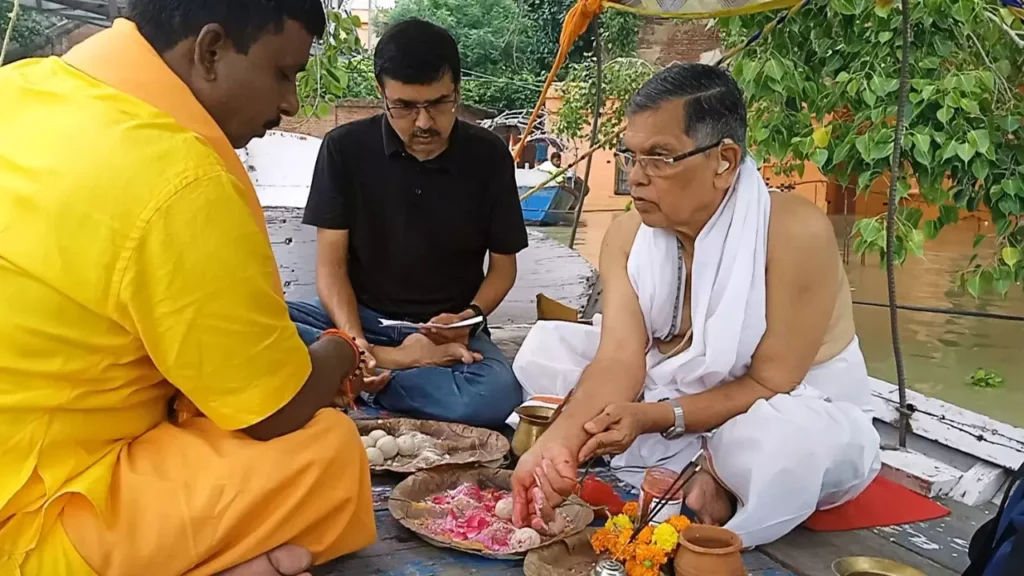
Pind Daan, the ritual offering of Pindas (sacred balls made of rice, barley flour, sesame seeds, honey, and ghee) to the ancestors, is a cornerstone of Pitrupaksha. Performing Pind Daan at Prayagraj, particularly on the banks of the Ganga or at the Sangam, is considered by many Shastras to be one of the most efficacious acts for ensuring the salvation (Sadgati or Moksha) of the ancestors. It is believed that offerings made at Prayag are readily accepted by the Pitrus, and the merit accrued is manifold. The presence of the Triveni, the Akshayavat, and the overall spiritual charge of the Teertharaj make it an unparalleled venue for this sacred duty. The atmosphere is thick with devotion as families, guided by learned Pandits, meticulously perform these rites, their prayers weaving a tapestry of love and remembrance. -
The Sacred Gathering of Saints, Sages, and Spiritual Masters
Pitrupaksha in Prayagraj often witnesses a unique and auspicious gathering of saints, sages, Mahatmas, and spiritual leaders from various traditions and lineages. These enlightened souls engage in profound spiritual discourses (Pravachans), share timeless wisdom from the scriptures, narrate ancient tales imbued with moral and spiritual lessons, and offer invaluable guidance to devotees on the correct performance of rituals and the deeper philosophical understanding of life, death, and ancestral duties. To be in the presence of such evolved beings, to listen to their words of wisdom (Satsanga), is an immense blessing that can clarify doubts, inspire devotion, and accelerate one’s own spiritual progress.
Personal Experiences: The Whispers of Faith and Divine Connection in Prayag
Converse with the pilgrims who journey to Prayagraj for Pitrupaksha, and your heart will be touched by countless narratives of faith, subtle intimations, and profound spiritual experiences. Many speak of feeling an inexplicable sense of peace after performing the rituals, of receiving auspicious signs, or even of ancestors appearing in dreams, their forms contented and radiant. For a vast number of devotees, performing Pitrupaksha shraddha in Prayagraj is not merely the fulfillment of a ritualistic obligation; it becomes a deeply transformative experience, a palpable connection with their lineage, and a tangible encounter with the divine grace that permeates this sacred land.

Counsel for the Earnest Spiritual Seeker Visiting Prayagraj for Pitrupaksha
Should your heart guide you to this sacred city during this auspicious fortnight, this old pandit offers a few humble suggestions:
-
Timing Your Sojourn: While the entire fortnight is sacred, endeavor to plan your visit to coincide with some of the particularly significant tithis (lunar days) within Pitrupaksha, or when notable spiritual gatherings are scheduled, for a truly holistic and immersive experience.
-
Seeking Wise Guidance: Engage with the learned Brahmins, Pandits, and Teerth Purohits of Prayagraj. Their knowledge of the intricate rituals and the specific significance of various sacred spots is invaluable. Approach them with humility and a genuine desire to learn.
-
Embracing Satsanga: Actively seek out and attend the spiritual discourses, kirtans, and gatherings of saints and sages. The wisdom shared during these times can be profoundly illuminating.
-
Observing with Reverence: Approach every ritual, every sacred site, and every tradition with utmost Shraddha (faith) and Vinamrata (humility). Maintain the sanctity of the place through your thoughts, words, and actions.
-
Cultivating Inner Receptivity: Beyond the external observances, allow yourself to truly immerse in the spiritual vibrations of Prayagraj. Let your heart be open, your mind receptive, and your spirit ready to receive the subtle blessings that this Teertharaj offers.
Conclusion: A Transformative Spiritual Sojourn Awaits the Seeker in Prayag
In summation, the observance of Pitrupaksha in the holy city of Prayagraj is far more than an adherence to ancient rituals; it is a profound journey into the very heart of Bharat’s spiritual heritage. It is an opportunity to fulfill a sacred ancestral duty in a place of unparalleled sanctity, to purify oneself in the holiest of confluences, to bask in the wisdom of enlightened souls, and to experience a deep, transformative connection with the divine and with one’s own roots.
Considering a rite for your own family?
Tell us what your family needs and a coordinator will contact you personally. No online payment is requested.
Send an enquiry