Simple Pind Daan: Guide to Offering and Making Pindas at home
This guide provides a compassionate walkthrough for making Pindas at home, transforming the sacred ritual of Pinda Daan into an accessible act of love. It explains that a Pinda is a symbolic body offered to nourish ancestors, made from simple, sattvic ingredients like cooked rice, black sesame seeds, ghee, and honey. The process begins with internal and external purity before detailing the meditative art of mixing and forming the three Pindas. It then outlines the offering ritual, from taking the Sankalpa (vow) to placing the Pindas on Kusha grass with reverence. The guide includes what to do with the Pindas after the ceremony and the importance of charity (Dakshina). It emphasizes that heartfelt devotion (shraddha) is the most crucial ingredient, making the rite powerful and meaningful even when performed simply at home.
Om Pitṛbhyo Namah.
Many feel that this rite requires a journey to a holy place like Gaya, Prayag, or my own beloved Varanasi. And while these Tirthas hold immense power, our scriptures, in their infinite compassion, have always taught that the most sacred ground is a heart filled with faith (shraddha), and the most powerful offering is one made with love.
Let us demystify this beautiful ritual. We will learn not just the “how” but the “why,” so that when you are making Pindas at home, you are not just following instructions, but are crafting a profound expression of love and gratitude for your ancestors.
Simple Pind Daan: Guide to Making and Offering Pindas at Home

The Soul of the Offering: What is a Pinda?
Before we gather the ingredients, we must understand what we are creating. A Pinda is far more than just a ball of rice. It is a symbolic body, a vessel of nourishment that we offer to our ancestors (Pitrs) in their subtle, ethereal realm. The act of offering it is called Pinda Daan—the charity of the Pinda.
Imagine your ancestor’s soul as a traveler on a long journey. The Pinda is the nourishing meal you pack for them, filled with your love, respect, and spiritual energy. Our Puranas tell us that by this offering, we can satisfy the hunger and thirst of our ancestors, help them find peace, and even liberate them from any unfortunate state they may be in, allowing them to continue their journey toward Moksha (liberation).
The Sacred Recipe: The Composition of a Pinda
The scriptures, in their vastness, mention many things that can be used for Pindas, from various grains to fruits and even specific types of meat in ancient times for satisfying the Pitrs for long periods. [i, c] However, for a householder performing a sattvic (pure) ritual at home, the most common, powerful, and recommended ingredients are simple and pure.
| Ingredient | Sanskrit/Hindi Name | The Spiritual Significance |
| Cooked Rice | Odan | The staple of life, representing physical substance and sustenance. |
| Barley Flour | Yava | An ancient and sacred grain representing abundance and strength. |
| Black Sesame Seeds | Krishna Til | Absolutely vital. Born from the sweat of Lord Vishnu, they absorb negativity and carry the essence of the offering to the Pitrs. |
| Clarified Butter | Ghee | The purest essence of milk, representing selfless love and providing light. |
| Honey | Madhu | Symbolizes the sweet essence of life and offers unending satisfaction (akshaya tripti) to the ancestors. |
For our guide on making Pindas at home, we will focus on a simple, powerful recipe using cooked rice as the base.

The Sanctity of Preparation: Before You Begin
The energy you put into the preparation is as important as the ritual itself.
Internal Purity (Atma Shuddhi)
The foundation of a meaningful Pinda Daan is your own inner state.
- A Calm Mind: Approach the ritual with a mind free from anger, haste, or anxiety. You are doing an act of love, not a chore.
- Faith and Devotion: Your shraddha—your unwavering faith—is the magic ingredient that activates everything else. Even a small offering made with sincere faith is immensely powerful. [c, m]
External Purity (Deha and Sthana Shuddhi)
- The Sacred Bath: Take a full bath before you begin. Feel the water washing away not just physical impurities but also mental distractions. After your bath, wear fresh, clean, simple clothes.
- The Sacred Space: Choose a quiet, clean spot in your home, ideally in the south-facing direction. The ground should be clean, free from dust or any impurities. Spread a clean mat (asan) for yourself to sit on.
A Step-by-Step Guide to Making and Offering Pindas at Home
Here is a simple, devotional sequence you can follow.
Part 1: The Art of Making Pindas at Home
This is a meditative act, not just cooking. Do this with a prayerful heart.
- Cook the Rice: Cook a small amount of white rice until it is soft and slightly overcooked, which makes it easier to mash and form. Let it cool until it is warm enough to handle.
- Prepare Your Workstation: In a clean bowl, take the warm cooked rice. Have your other ingredients ready: a bowl of black sesame seeds, a small pot of ghee, and a small pot of honey.
- Mash and Mix: Using your clean right hand, gently mash the rice. As you do this, think of your ancestors with love and gratitude.
- Combine the Ingredients: Add a generous spoonful of black sesame seeds, a spoonful of ghee, and a spoonful of honey to the mashed rice.
- Mix with Intention: Mix all the ingredients thoroughly. Feel that you are infusing the mixture with your love and prayers. You are not just mixing food; you are creating a potent offering of spiritual energy.
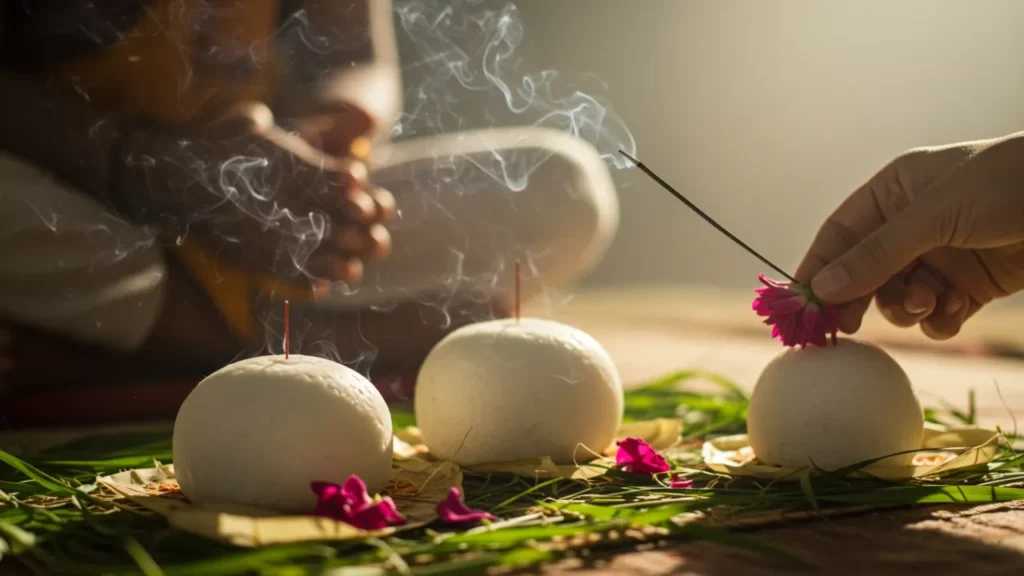
- Form the Pindas: Traditionally, three Pindas are offered for the three preceding generations. Take a portion of the mixture and gently roll it in your palms to form a smooth, round ball. The scriptures charmingly suggest the size should be about what could fit in the mouth of a two-year-old calf [u], or roughly the size of a large lemon. Create three such Pindas and place them on a clean plate.
Your sacred Pindas are now ready. You have just completed the core part of making Pindas at home.
Part 2: The Ritual of Offering (Pinda Daan)
- Prepare the Offering Ground: In front of your sitting mat, place a few blades of Kusha grass with the tips pointing South. This will be the sacred altar for the Pindas. [p]
- Sankalpa (The Vow of Intention): This step is vital. Take a little water, a flower, and a few rice grains in your right palm. Close your eyes and state your intention: “Today, I [Your Name], of the [Your Gotra] gotra, am offering these Pindas for the peace and satisfaction of my father [Father’s Name], my grandfather [Grandfather’s Name], my great-grandfather [Great-Grandfather’s Name], and all my ancestors. May they accept this offering.” Let the water fall to the ground.
- The Offering: Now, with utmost reverence, perform the Daan. If you wear a sacred thread (janeu), ensure it is in the Prachinaviti position (over the right shoulder).
- First Pinda (for your Father): Take the first Pinda in your right hand. As you place it gently on the Kusha grass, say, “[Father’s Name], of the [Gotra] gotra, this Pinda is for you. Pitṛbhyaḥ Svadhā.” (Svadha to the ancestors).
- Second Pinda (for your Grandfather): Take the second Pinda and place it next to the first, saying, “[Grandfather’s Name], of the [Gotra] gotra, this Pinda is for you. Pitṛbhyaḥ Svadhā.”
- Third Pinda (for your Great-Grandfather): Take the third Pinda and place it, saying, “[Great-Grandfather’s Name], of the [Gotra] gotra, this Pinda is for you. Pitṛbhyaḥ Svadhā.”
- Worship the Pindas: Your ancestors are now symbolically present. Worship the offered Pindas as you would a deity.
- Offer Water: With a small spoon, offer a little clean water over the Pindas. [g]
- Offer Flowers & Incense: Offer fresh, simple flowers. Light a stick of incense and wave it gently before the Pindas.
- Offer Light: Wave your ghee lamp before them.
- Prayer and Forgiveness: With your hands folded, gaze at the Pindas and pray from your heart. Thank your ancestors. Ask for their blessings. Then, humbly ask for forgiveness for any mistakes: “Any shortcoming or redundancy out of my ignorance may be made complete always.” [f]
After the Offering: Concluding the Rite with Grace

The ritual doesn’t end abruptly. The conclusion is just as important.
What to Do with the Offered Pindas?
The sacred Pindas must be treated with respect. Our scriptures suggest several beautiful ways to complete the offering, depending on what blessings you seek:
- For Wisdom and Fame: Immerse the Pindas in a clean, flowing river, lake, or the sea. [c]
- For Splendor and Health: Offer the Pindas to a cow to eat. This is a very common and meritorious practice.
- For Longevity: You can offer the Pindas to crows.
- If None of the Above Are Possible: You can place the Pindas under a Peepal tree or bury them in a clean spot in your garden where no one will step.
Gifts and Charity (Dakshina)
A Shraddha ritual is traditionally completed with an act of charity.
- Feed a Brahmin: If possible, offering a meal to a learned and pure Brahmin is considered highly auspicious.
- Give to the Needy: You can also donate food, clothes, or money to the poor or to a temple in the name of your ancestors. The act of giving completes the cycle of receiving blessings and sharing them with others. [g, r]
A Pandit’s Counsel for the Modern Family
- “What if I don’t know my Gotra or the names of my great-grandfathers?” Do not let this stop you. Your intention is what connects you. You can simply say, “To my father,” “to my father’s father,” and “to my father’s father’s father.” And finally, make an offering to “all my known and unknown ancestors.” They will receive it.
- “My Pindas are not perfectly round!” The shape is symbolic. The ancestors receive your love (bhava), not the geometric perfection of the Pinda. A lumpy Pinda offered with a loving heart is infinitely more valuable than a perfect sphere offered without feeling.
- “This still feels complex. Where can I get more help?” It is natural to seek guidance. For those who wish to understand the rituals more deeply, or need help connecting with a qualified pandit, resources like pitrupaksha.org are invaluable. They are a modern bridge to our ancient traditions, created to help families like yours.
Conclusion: Simple Pind Daan: Guide to Offering and Making Pindas at home
I hope this guide has shown you that making Pindas at home is not only possible but is a profoundly beautiful and intimate act of love. You are continuing a sacred chain of remembrance that has flowed through our land for thousands of years.
Do not fear. Do not doubt. Gather your simple ingredients, cleanse your heart, and make your offering. Your ancestors are not waiting to judge your technique; they are waiting to receive your love. And in return, their blessings will rain down upon you and your family, bringing peace, prosperity, and spiritual protection.
Aashirvaad.
Considering a rite for your own family?
Tell us what your family needs and a coordinator will contact you personally. No online payment is requested.
Send an enquiry