Kusha Grass Significance: Divine Origins, Purifying Power & Sacred Legends
What makes humble blades of Kusha grass so indispensable and revered in Hindu rituals, from grand Yajnas to intimate Shradh ceremonies? Is there a deeper Kusha grass significance beyond its simple appearance? The ancient Puranas unveil astonishing truths, tracing its origins to the very beings of the Creator, Lord Brahma, or the Preserver, Lord Vishnu. Could it be that these divine connections imbue Kusha with unparalleled sanctity? Imagine a single blade of grass holding the essence of the entire Hindu Trinity – Brahma at its root, Vishnu in its middle, and Shiva at its tip. How does this extraordinary indwelling presence contribute to its famed 'Pāvaka Shakti,' its unmatched power to purify sacred spaces, offerings, and even the performers of rituals? And why is it deemed crucial for ancestral rites, serving as a pure seat for Pindas and a conduit for our heartfelt offerings to reach the Pitṛs? Journey through divine legends, including its contact with Amrita (nectar of immortality) and its transformation into a divine weapon, to fully grasp why this unassuming grass is a cornerstone of Sanatana Dharma.
Namaste,
It seems like ordinary grass, yet it is treated with such reverence. Why? What is the secret behind its sacredness? What power does it hold? Let us explore the Kusha grass significance as revealed through the wisdom of our Puranas and the experiences of countless generations.
Kusha Grass Significance: Divine Origins, Purifying Power & Sacred Legends
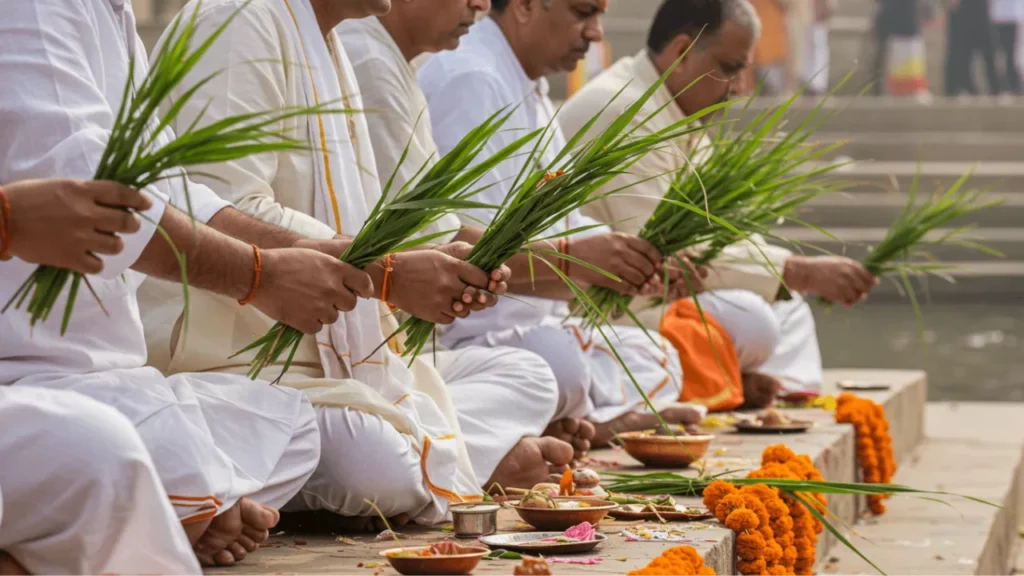
In our sacred traditions, Kusha grass isn’t just vegetation; it’s a ritual implement of paramount importance, a conduit for divine energy, and a powerful purifying agent. Its significance stems from its divine origins and the very deities who reside within its form.

Divine Origins: Born from the Gods Themselves
How did this specific grass gain such elevated status? Our Puranas offer fascinating accounts, all pointing towards a divine source, which is the root of Kusha grass significance:
- From the Creator’s Being: Some traditions, echoed in the Skanda Purana, tell a profound story. They say that Kusha grass (sometimes referred to as Kasa grass in this context) originated from the very hairs that fell from Prajapati Brahma, the Creator of the universe – the essence of the cosmic architect manifesting as these humble blades. This direct link to the source of creation imbues it with inherent sanctity.
- From the Preserver’s Form: Another equally revered account, found in the Garuda Purana and also mentioned in the Skanda Purana, connects Darbha directly to Lord Vishnu, the Preserver. These texts state that Darbha grass was born from the hairs of Lord Vishnu himself! Just as til or gingelly seeds (sesame) are said to have originated from his divine sweat (sveda), Darbha grass sprouted from his very being.
Think of it: whether from Brahma or Vishnu, the grass is not merely earthly. It is a fragment of the divine, manifested in a form we can interact with, touch, and utilize in our sacred practices. This divine origin is the bedrock of its power and purity.
The Trinity Within: A Microcosm of Divine Power
The sacredness of Darbha grass deepens further when we understand who resides within its structure. The Garuda Purana and the Skanda Purana reveal an astonishing truth: the Trimurti, the divine Hindu Trinity, have made their abode within these blades!
- At the Root (Mūla): Lord Brahma, the Creator, is stationed.
- In the Middle (Madhya): Lord Keshava (a name for Vishnu), the Preserver, resides.
- At the Tip (Agra): Lord Shankara (Shiva), the Transformer/Destroyer, is present.
Every single blade of Darbha grass holds the combined energy, blessings, and power of Brahma, Vishnu, and Maheshwara! It is a miniature powerhouse, a sacred antenna tuned to the highest divine frequencies. This indwelling presence of the Trinity makes Kusha grass an unparalleled tool for purification, protection, and connecting with the divine during rituals. When a priest holds Kusha, they are symbolically holding the essence of the entire Godhead in their hands. This triune residency is a core aspect of Kusha grass significance.
Pāvaka Shakti: The Unmatched Power of Purification
Given its divine origins and the presence of the Trinity, it logically follows that Kusha grass possesses immense purifying power (pāvaka shakti). Our scriptures and traditions utilize it extensively for this very purpose:
- Sanctifying Ritual Items: Blades of Kusha are often dipped in water, and this water is then sprinkled (prokṣaṇa) on ritual implements, offerings, the place of worship, and even the participants to purify them. Sometimes, just touching an object with Darbha is considered sufficient for purification.
- Making Pavitra: Specific rings or loops made from Darbha grass, called Pavitra or Pavitri, are worn by the priest (often on the ring finger) during rituals. This continuously purifies the performer and ensures their actions remain ritually clean. These pavitras are also used to sprinkle ghee (clarified butter) into the sacrificial fire, ensuring the offering is pure.
- Inherent Purity: The Garuda Purana and Skanda Purana make a remarkable statement: Brahmins (those dedicated to sacred knowledge and rites), Mantras (sacred sounds), Kusha grass, Agni (fire), and the Tulasi plant possess a unique quality – they never become impure in an absolute sense, even with repeated use in various contexts. While there are specific ritual nuances (which we will touch upon), their fundamental nature remains pure. Fire itself, Agni Deva, is considered purified when enveloped by uncut Kusha grass! Water sprinkled with Darbha attains purifying power even without the chanting of specific mantras, such is the inherent energy of the grass.
This purifying quality is essential because our rituals aim to create a sacred space, free from negative influences, allowing for clear communication with the divine and the ancestors. Kusha grass is a primary tool for achieving this sacred state.
Vital Role in Sacred Rites: Yajna and Shradh
Kusha grass is not merely optional; it is often indispensable for the correct performance and efficacy of our most important ceremonies.
In Yajnas (Fire Sacrifices):
From simple Homas to complex Yajnas, Darbha is integral:
- Defining Sacred Space: It is often used to demarcate the boundaries of the sacrificial altar (vedi).
- Ritual Actions: Priests use Kusha blades for various specific actions related to the fire and offerings, such as symbolically scraping sacrificial ladles clean, touching offerings, creating loops for specific purposes, and managing the sacred fire itself. Its presence ensures the sanctity and proper flow of the ritual energies.
In Shradh (Ancestral Rites):
Perhaps nowhere is the Kusha grass significance more visibly demonstrated than in the rites performed for our Pitṛs (ancestors).
- Seat for Pindas: The Pindas (rice balls offered to ancestors) are traditionally placed upon a layer of Kusha grass spread on the ground. The Garuda Purana states this is done for the prosperity (samṛddhi) of the offerer, implying the grass channels blessings back from the satisfied ancestors. It acts as a pure base, insulating the sacred offering from any impurities of the ground and facilitating its subtle transmission.
- Pleasing the Ancestors: The scriptures assure us that holy rites performed using Darbha grass bring deep satisfaction (tṛpti) to the Pitṛs. The grass acts as a conduit, carrying the essence of the offerings and the devotion of the descendants to the ancestral realm.
- Connection to the Sacred Thread: The Yajnopavita (sacred thread) worn by the twice-born is essential for performing Shradh. Its sanctity is deeply linked to elements like Darbha grass and sesame seeds, which are used in its consecration and associated rituals. Wearing the thread correctly during rites (over the right shoulder for Pitṛ karya) propitiates the manes, and Darbha is part of this entire ritual complex.
- A Point of Ritual Nuance: Interestingly, the Garuda Purana and Skanda Purana, while extolling Kusha’s purity, add a subtle point of ritual knowledge: Kusha grass used specifically with Pindas during Shradh is considered to become ritually impure after that specific use (likely because it has absorbed the subtle connection to the departed). This doesn’t negate its overall purity but highlights that even sacred items have precise rules governing their use and disposal within specific ritual contexts. It reminds us of the intricate science behind these practices.
Its presence in Shradh ensures the purity of the offering, the proper connection to the Pitṛs, and the efficacy of the entire rite aimed at ancestral well-being and liberation.
Beyond Ritual: Legends of Divine Power
The power inherent in Kusha grass sometimes manifests in truly extraordinary ways, as recounted in our Puranas:
- Dadhichi’s Divine Weapon: The Siva Purana narrates a breathtaking incident. The great sage Dadhichi, renowned for his austerities and the sacrifice of his bones to craft the Vajra (thunderbolt) for Indra, once faced a challenge from the Devas. To demonstrate his power, derived from his devotion to Lord Shiva, Dadhichi simply took a handful of Kusha grass, infused it with divine energy by remembering Lord Shiva, and threw it. Those humble blades instantly transformed into a blazing divine trident (trishula), as powerful as the fire of cosmic dissolution (kālāgni)! This legend vividly illustrates that when empowered by mantra, devotion (bhakti), and divine grace, Kusha grass can transcend its simple form and become a potent instrument of divine will, capable of protecting Dharma and destroying evil.
- Sanctified by Nectar (Amrita): A curious legend from the Skanda Purana adds another layer to Kusha’s sanctity. During the Samudra Manthan (Churning of the Ocean), after the pot of divine nectar (Amrita) was recovered, it was briefly placed upon a seat of Darbha grass before being distributed. The cunning snakes (Nagas) later tried to lick the residual nectar from the grass. While they didn’t get the nectar and instead had their tongues split by the sharp edges (hence becoming ‘double-tongued’, dvi-jihva), the Darbha grass itself absorbed the vibrational essence of the Amrita. This contact with the nectar of immortality further enhanced its already profound sacredness and purifying power.
These legends underscore that Kusha is not passive; it can actively channel and even manifest divine energy under specific conditions.

Sanctifying Space: The Kusasthali Example
The very presence of Kusha grass can sanctify a location. The Skanda Purana describes a place called Kusasthali. Here, Lord Brahma spread Kusha grass on the ground and seated Lord Purushottama (Vishnu) upon it while eulogizing Him. This act of using Kusha as a sacred seat elevated the sanctity of the entire area, making it a holy Tirtha.
Sacred Blades: A Summary of Kusha Grass Significance
Why do we hold these simple blades of grass in such high esteem? Let us gather the threads of wisdom:
- Divine Origin: Kusha grass springs from the very being of the highest Gods – Brahma or Vishnu – making it inherently sacred.
- Indwelling Trinity: The divine Trinity – Brahma, Vishnu, and Shiva – reside within each blade, making it a powerhouse of cosmic energy.
- Supreme Purifier: It possesses an unmatched ability to purify objects, spaces, and individuals involved in sacred rites.
- Ritual Necessity: It is indispensable for the correct and effective performance of Yajnas (fire sacrifices) and Shradh (ancestral rites), acting as a conduit and ensuring purity.
- Connection to Ancestors: It plays a vital role in satisfying the Pitṛs and facilitating the transmission of offerings like Pindas.
- Potential Divine Power: Legends show it can be transformed into a divine instrument or weapon through devotion and mantra shakti.
- Nectar Connection: Its sanctity was further enhanced by contact with the divine nectar, Amrita.
- Sanctifier of Space: Its presence can elevate the spiritual vibrations of a location.
This profound Kusha grass significance explains why it is treated with reverence and used so meticulously in the rituals that form the bedrock of our Dharma.
Conclusion: Respecting the Humble, Honoring the Divine
Next time you see Kusha or Darbha grass being used in a ceremony, look beyond its simple appearance. Remember the Creator, the Preserver, the Transformer residing within. Remember its journey from the heavens, its touch with nectar, its power to purify, and its role as a bridge to our ancestors.
Treating even the humblest elements of our tradition with understanding and respect deepens our own connection to the divine fabric of existence. Kusha grass is a beautiful reminder that sacredness permeates all of creation, often hidden in plain sight, waiting for the eyes of wisdom and the heart of devotion to recognize it.
|| हरि ॐ तत् सत् ||
Considering a rite for your own family?
Tell us what your family needs and a coordinator will contact you personally. No online payment is requested.
Send an enquiry